
Financial Planning
You wouldn't start a hike without knowing your destination and mapping the route, would you? It's equally important to know where you're going financially, and having a plan for how to get there. A good financial plan helps define your goals and serves as a guide for the path ahead.
When we know where we are, and where we want to end up, it's easier to figure out what it will take to get us there. Without a plan, how can we know if we are saving enough or investing appropriately? In times of uncertainty, a financial plan can also help assure clients that they are still on track to meet their goals.
“Planning is bringing the future into the present so that you can do something about it now.”Alan Lakein
- 1
Bye, bye spreadsheets
No more straight-line math or static spreadsheets. Accurate, sophisticated projections are critical to proper financial planning. We use secure, cloud-based software and Monte Carlo simulations for all future-date predictions, the same type of trusted modeling assumptions used by banks and life insurance companies.
- 2
Secure asset aggregation
Enter asset and allocation details manually, or securely link your outside accounts so values and changes update automatically. Our planning implementation uses HTTPS rated A+ by independent Qualys SSL Labs, with 2048-bit asymmetric and 256-bit symmetric encryption.
- 3
Personalized for you
No two clients are alike. Every plan is completely personalized to you, your goals, and your priorities, incorporating customized behavioral risk profiling for a perfect fit.
- 4
Clarity from complexity
Your finances may seem complicated; we help bring clarity. Our plans provide detail and highlight what matters, so you understand the impact of different scenarios, asset allocations, and stress tests.
- 5
Optimize your cash flow
A comprehensive plan can also optimize the timing of income streams like Social Security and RMDs for maximum tax-efficiency, informing the choices we make today, not just the future.

Asset Management
Our investment philosophy starts with a simple truth: high quality assets are worth more than low quality assets.
It sounds obvious, but it's a foundational concept many investors forget when confronted with a complex and compelling narrative, or when the potential for profit or loss becomes emotional. Evidence shows that many characteristics of high-quality companies are persistent and that, counter to the principles of market efficiency, quality investments can produce higher long-run shareholder returns.*
Different objectives require different tools. Split Creek uses a dynamic investment review process, customized to each client's goals and the asset in question, but we always evaluate profitability, growth, and safety/risk, emphasizing, depending on the mandate, balance sheet, governance & ESG; growth & profitability; valuation & timing; and risk.
Portfolio Optimization
Your portfolio should be customized to reflect your goals. It was built with money you earned.
ETFs and mutual funds are generally passive and impersonal. The fund manager doesn't know you and won't change the profile of the fund to match yours. Unfortunately, many portfolio managers offer an experience only slightly better: you get assigned to the manager's “growth model,” but what does that really mean for your goals?
At Split Creek Capital, we work with you to align you and your risk profile with your financial plan and a customized investment portfolio. Benchmarks like the S&P 500 help set expectations, but overly rigid alignment to a benchmark limits flexibility. When conditions deteriorate, advisors tend to paint risk with an overly broad brush. A binary “risk on” or “risk off” mentality ignores the multitude of factors that influence every investment: a homebuilder might be more sensitive to rising mortgage rates, while a spike in crude could hurt airline profits. We go beyond high-level asset-class allocations and evaluate security-level risk and reward from many interconnected factors.
Our equity review process
Many advisors screen: each stage of the funnel removes stocks that miss a cutoff. Screening has two significant shortcomings. There are no objectively “best” practices for where to set the cutoffs, and it hides potentially attractive investments that miss on a single criterion. Our scoring system standardizes data points so they can be compared: data that are good relative to the investment universe contribute positively to a final score; weaker elements contribute negatively. That lets us weight important factors, rank opportunities, break out the contribution components, control for outliers, and compare investments across industries. A bit more work than a simple filter, but a much greater degree of insight.
Example
Here we took a look at the S&P 500 and at each stage of the screen, we filtered out stocks that had numbers that were ‘worse’ than the benchmark average. Remember, there are no rules on how to define the filter cutoffs, “better than average” is a reasonable place to start. While we did succeed in cutting down our investment universe, the screen also dropped some potentially compelling investments. For instance: Alphabet (GOOGL – the parent company of Google and YouTube) has a P/S ratio of 5.65x vs the 4.27x average & cutoff, and a profit margin of 29.51% vs the average & cutoff 13.57%. Some would say that it’s worth paying a slight sales premium given the superior margins. The point of this illustrative example is not to argue for or against GOOGL, but rather it is to highlight that one of the most common steps in the investment process, may be concealing ‘hidden’ opportunities.
Stock screening
Many advisors use a screening process to find investments. You may be familiar with stock screening as many websites and investment platforms (like Schwab) make screening tools available for free. Each ‘stage’ of the funnel screens out (removes from consideration) stocks that don’t meet the defined criteria. So if you set the price-to-earnings (P/E) ratio at 21x, you won’t see any stocks with a P/E ratio higher than 21x. While this technique can help narrow the field of potential investments, it has two significant shortcomings: (1) There are no objectively ‘best’ practices for where to set the filter cut-offs. (2) Screening often hides potentially attractive investments that miss on a single criterion.
Security scoring
A scoring system is a little different. Here we standardize various data points, so that they can be compared to one another. Data that are good relative to the investment universe result in a positive + contribution to the final score. Elements that are worse than the scored universe result in a negative – contribution. This allows us to better evaluate stocks with different potential return drivers (Example: a value stock with average growth vs a stock with impressive growth and a lofty valuation). Scoring also allows us to weight important factors, rank the output, break-out the contribution components, control for outliers, and better compare opportunities from different industries. It’s a bit more work than a simple filter / screen, but gives us a much greater degree of investment insight.
*See Asness, Frazzini and Pedersen, “Quality Minus Junk” (working paper, October 2013), finding that high quality stocks remain high quality stocks up to 10 years later. Cited as research background; not a guarantee of future results.
Alternative Investments
As a complement to traditional assets, the addition of select, appropriate, alternative investments may improve portfolio outcomes for many clients.
A properly constructed portfolio which includes alternatives should reduce overall risk, and provide higher potential return compared to a traditional balanced portfolio.
“Alternative investments” is a broad category, which can evoke feelings of anxiety and alienation for some, and a sense of excitement for others.
“The challenges facing investors seeking to build portfolios capable of generating attractive returns with acceptable levels of risk may never have been greater. The traditional 60% stock / 40% bond portfolio mix that has worked effectively for many years needs to be reconsidered.”J.P. Morgan Asset Management

To demystify “alts”, we can start by breaking them down into three types: Core, Core Complements, and Return Enhancers.
Because of their often complicated structures, long investment horizons, and limited liquidity, we recommend an outcome-oriented approach: first identify the problem or investment need not readily met by traditional assets, then seek to identify which, if any, alternative asset class and structure is most appropriate.
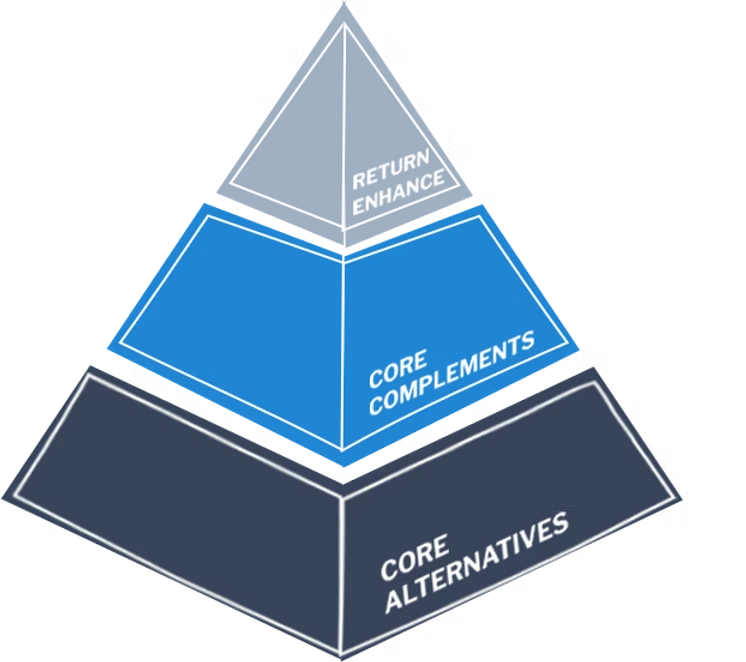
Core
The foundation of an alts allocation: from fixed income-like private credit, to hybrid private-market core real assets offering steady income and some appreciation, to more equity-like low-vol and real asset strategies. Core alts can potentially be higher-returning substitutes for traditional fixed income and equity.
Core Complements
Hedge funds and other real assets that complement the core, diversifying return drivers beyond stocks and bonds.
Return Enhancers
Higher risk/reward private equity and distressed strategies, used selectively to further diversify the alts allocation and provide for more resilient long-term outcomes than core alternatives alone.
Please read the risk disclosure: alternative investments involve illiquidity, long horizons, and risk of loss, and are not suitable for all investors. See the disclosures below and our Form ADV Part 2 before considering any alternative investment.
Important disclosures
The firm's existing footer disclaimer appears verbatim in the footer of every page.
- Projections are hypothetical. Financial plans, Monte Carlo simulations, and scenario analyses are illustrative tools based on assumptions about the future. They are not predictions or guarantees, and actual results will differ, possibly significantly.
- Optimization scenarios are illustrations. Portfolio optimization examples show an approach to managing exposures; they do not represent the performance of any actual account and should not be read as a promise of reduced risk or enhanced return.
- Alternatives carry distinct risks. Alternative investments are often illiquid, involve long investment horizons and complex structures, may not be suitable for all investors, and some are limited to investors who meet eligibility requirements. You could lose some or all of an alternative investment.
- Past performance does not guarantee future results. All investing involves risk, including the possible loss of principal. No strategy, including asset allocation, diversification, or quality-focused investing, assures a profit or protects against loss.
- Not tax or legal advice. Split Creek Capital does not provide tax or legal advice. Coordinate with your CPA and attorney on decisions with tax or legal consequences.
- Registration is not an endorsement. Registration with the U.S. Securities and Exchange Commission as an investment adviser does not imply a certain level of skill or training, and the SEC has not approved or verified the content of this website.
- Read the official documents. Before engaging us, review our Form ADV ↗, Form ADV Part 2 Brochures ↗, and Form CRS ↗, which describe our services, fees, and conflicts in full.